


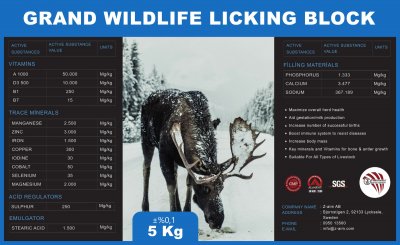


Z-aim Grand Wildlife lick blocks consist of salt, minerals and vitamins in a composition designed to promote the animal's ability to better absorb minerals and nutrients and to improve the health status and improve the growth and quality of horns and clovers.
The salt stone contains lots of important substances and also the vital vitamin B Tiamin, which has been extensively rewritten in the end! For example, deficiency of B1 in animals has begun to be considered as the cause of the emaciation disease in elk that often causes them to die. In addition to moose, it has also begun to be expressed that the reduction of seabirds and death among salmon fry, problems for cod may also be due to thiamine deficiency. Without sufficient amounts of thiamine, serious problems arise with the body's ability to absorb foods from the food they eat, which in the worst case results in death.
Wild feed intake often occurs in environments that have been used for a long time and studies and data show that the content of certain minerals, vitamins and trace elements is often too low. A supplement therefore benefits the game positively. Swedish chips also naturally hold low values.
Supplementing with Grand Wildlife can provide several benefits!
Better general status on all animals.
Increased digestive capacity and milk production.
Improved birth status.
Better immune system and lower disease risk.
Increased body weight / growth.
Key minerals and vitamins for the growth of bones, horns, hoofs, hoofs.
Suitable to use for all ruminants and cattle.
A higher amount of minerals stored in the skeleton is positive, for example most of the building material during horn development is taken directly from the skeleton as a shoulder blade and more. If the skeleton has a low content of the necessary minerals, then the supply quickly ends and after that the horns only develop from minerals that come directly from the food that the animal is currently eating. An animal with a sufficiently high intake and uptake of minerals, important vitamins etc. is thus given a better condition for building up its horns.
Vitamins in Grand Wildlife lick blocks:
Vitamin A: Growth, antioxidant, saliva, epithelial production, eyes
Retinol is needed for vision, skin and mucous membranes to function normally. Vitamin A has a fundamental importance for the development, growth and differentiation of the embryo during the earliest part of pregnancy, in order for the fetus to develop normally and have a good vision.
B7 Biotin: Hair, hoof, horn development and quality.
Like other B vitamins, biotin helps the body break down carbohydrates, fats and proteins during energy production. It also contributes to maintaining healthy skin, hair and nervous system function and is a very important topic for the development / build-up of horns and clefts.
B1 Thiamine: Energy, digestion, nervous system, appetite.
Thiamine is an important nutrient that all tissues in the body need to function properly. Thiamine was the first vitamin B discovered by scientists, hence the name B1. Like other B vitamins, thiamine is water-soluble and important for the body to convert food into energy. Lack of thiamine can lead to malnutrition and even death. Deficiency of vitamin B1 is believed to be the cause of emaciation in elk, death of seabirds and salmon fry and, at present, probably also for cod in Swedish water.
D3: eyes, bioavailability, horn development, bone development, cloven tissue development.
Vitamin D is a very important nutrient as it is involved in about 100 body functions. Vitamin D is a steroid vitamin, a group of fat-soluble prohormones that help maintain the balance of calcium in the body, important for normal growth and for the interaction of mineralization of bones and teeth. Extensive and ongoing research on vitamin D has also shown new roles for this vitamin in modulating cell growth, neuromuscular and immune functions.
Minerals in the Z-aim Grand WildLife
Manganese Oxide: Manganese Oxide: Bones, tissue, reproduction and hormones. In studies on deer, the mineral has been found to play a major role for the strength and flexibility of horns and bones, a low value giving fragile horns that can withstand less. Among the minerals that can affect the mechanical properties of horns and bones, the substance seems to have a disproportionate importance, given its small content in the overall structure! A strong skeleton is also of high importance under the rut of the deer animals, animals with low values after the development of the horn may have a weakened bone structure.
Zinc: hoof and hair quality, circulatory system, growth of young animals, reproduction A sufficiently high level of Zinc in studies on white-tailed deer in hedge has shown that the animals received a better immune system and a higher stress resistance. The effect was most noticeable in older animals.
Iron: Anemia, cell structure, respiration, growth and development. Iron is part of hemoglobin and myoglobin and has the vital function of transporting oxygen in the body. 70% of the iron is bound to the hemoglobin, the remaining 30% is found as the protein complex ferritin in kidneys,
ver and spinal cord. Iron deficiency is rare as feed is often rich in iron sufficient to meet normal needs. The exception is calves that exclusively feed animals or animals infected by parasites or suffer from a disease that leads to chronic blood loss. Lack of iron can lead to anemia, recklessness, reduced feed intake and reduced growth. Pale mucous membranes can be used as an indication of iron deficiency. When iron deficiency is noticed, this is usually noticed by the animal being deprived of copper utilization and then exhibiting the symptoms of copper deficiency.
Copper: Pigmentation, hair quality, breathing, bone formation, development of connective tissue. Among other things, it is a component of the red blood cells whose task is to transport oxygen and carbon dioxide. Lack of copper results in impaired uptake of iron from the small intestine as well as impaired mobilization of iron from tissues leading to a decreased synthesis of hemoglobin and therefore impaired oxygen supply to cells and tissues. Copper also plays an important role in various enzyme systems and is also necessary for normal pigmentation of the coat.
Iodine: important for the offspring and fetal development, cleft, horn development are included in thyroid hormones thyroxine and triiodothyronine which are necessary for growth and development. Iodine deficiency can cause hypothyroidism which in turn can lead to stroma. Good supply of iodine lowers the turnover of selenium, which makes iodine a good aid in maintaining selenium levels. Calves born with a deficiency run the risk of having Weak calf syndrome, WCS, they are fully developed but not normal. Symptoms of iodine deficiency in addition to enlarged thyroid gland may be late abortions, hairless calves, decreased fertility, residual afterbirth, increased susceptibility to infection. The risk of iodine deficiency increases if the feed supply contains a high proportion of legumes as these may contain high levels of goitrogens competing for the absorption of iodine.
Cobalt: Blood production, body development, milk exchange, hair, hoof development Vomen's microorganisms need cobalt for the production of, for example, vitamin B12! In the event of a deficiency, the animals lose weight quickly and signs of malnutrition occur. This can be explained by the fact that the metabolism of propionic acid is dependent on vitamin B12. Cobalt deficiency can be distinguished by reduced appetite, lower growth and a lower concentration of vitamin B12 in the blood (plasma) and the liver. Cobalt is stored in an extremely small amount in the body and it is common to use vitamin B12 in plasma instead and live as an indicator of the cobalt level of ruminants.
Selenium (Selenium): important for fetal development, hair, hoof, horn development, reproduction, growth, muscle development, immune system, antioxidant. Swedish chips are poor on selenium, the distribution of selenium very uneven across the world. Countries such as Sweden, Finland and several other northern European countries have a lack of selenium in the soil. The best solution is to add selenium in animal feed, which we do for livestock in Sweden, many people also use selenium as a dietary supplement. Selenium is one of seven widely recognized micro minerals needed in the diet of animals. Today, we know that selenium is present in all our cells and is critical for a number of body functions, including the cells' energy production - including in the muscle cells and not least the cells of the heart that require a lot of energy. A low level of selenium can cause a number of serious problems in calves as well as adults. Selenium and vitamin E interact and are important to each other.
Magnesium (Mg): Acidosis, constipation, poisoning, carminative, antacid, constructive diarrhea, intestinal flora. The substance has several important metabolic functions in the production and transport of energy. It is also important for muscle contraction and relaxation. Magnesium is involved in the synthesis of protein, and it helps activate some enzymes. For animals, it is important in the metabolism of carbohydrates, lipids (fats) and protein. Also used for nerve activity and muscle contraction.
DCP Phosporus (Phosphorus) Bone development, horn development, splitting, muscle development, acid-base balance, hypophosphataemia milk exchange, hypophosphataemia. Minerals in a compound feed work together like spokes on a wheel. If a spokesman is broken, the tire will wobble. A good example is how calcium and phosphorus interact. Before any calcium can be turned into horns or bones, enough phosphorus must be present and before these two can interact, sufficient VITAMIN D must be present in the animal's diet. There are many "game minerals" on the market that have a high level of salt and perhaps a significant level of calcium but then a low or virtually no phosphorus or other important minerals, trace minerals or vitamins. Calcium and salt are very cheap while PHOSPHORUS and other important minerals, chelated trace minerals and vitamins are the most expensive elements in a product.
Sulfur (Sulfur) Sulfur is an important component of proteins, amino acids, enzymes, vitamins and other biomolecules. Most of the sulfur in the animal body is in pro
proteins containing the amino acids cystine, cysteine and methionine. Sulfur is also found in the hormone insulin and the important metabolite coenzyme A. Cartilage, skeletal bone, tendons and blood vessel walls also contain sulfur. Addition of sulfur has a good effect on the uptake of nutrients by ruminants, especially for the digestion of plant wires by absorption and uptake of nitrogen. Sulfur is needed for the synthesis of certain amino acids, vitamins and certain enzymes so that the microorganisms of the heat can utilize sodium sulfate and methionine. Wet microbes can better break down dietary proteins into ammonia and sulfides or use dietary urea and sulfate to synthesize microbial proteins. Sulfur can also promote the growth of ciliates in rumen rumen, actively participate in protein and fat metabolism and oxidation processes, and participate in the detoxification of harmful phenolic compounds to the benzene sulfuric acid form, promote the synthesis of sulfur-containing amino acids, and increase the body's resistance.
Stearic Acid: Binder and energy source.
Stearic acid is a saturated fatty acid with a chain of 18 carbon atoms, and is, after Palmitic acid, the most common in nature. It is usually found in the largest amount in animal products, but it is also found in smaller amounts in vegetable, with the exception of coconut butter and shea butter where the acid is very prominent, with a stearic acid content between 28 - 45%. A study of stearic acid in humans showed that stearic acid, among other things, was less likely to associate with cholesterol esters, and in other epidemiological and clinical studies, the acid was associated with reduced LDL cholesterol compared to other saturated fats. This may indicate that stearic acid is more useful than other saturated fats.
Calcium carbonate (Calcium): Hypocalcemia, bone development, milk exchange, immune system. Carbonated lime is common in nature a lot and occurs as aragonite, limestone, limestone, chalk and marble, as well as in marble, dolomite, etc. Lime is an important component of the horns.
Sodium chloride (Salt) Acid and liquid balance, digestion. Is called Sodium Chloride and is the chemical name of salt. Sodium is an electrolyte that regulates the amount of water in the body. Sodium also plays a role in nerve impulses and muscle contractions. The salt is also a good 'lid' for deer animals.
Z-aim Grand Wildlife Slick blocks have a significantly higher salt content than Grand Wildlife PREMIX and are more geared as a year-round complement to moose and deer! Some animals, such as deer, wild boar, etc., do not like or need to consume any large amount of salt. So for the support feeding of deer, deer and wild boar, you instead choose PREMIX which is mixed directly in the feed, sprinkled on hay bale etc and contains much less salt but an even higher number of other promoting substances.
The story why we made Z-aim Grand Wildlife lick blocks & PREMIX is simple. For a number of years we tested ourselves to boost the intake of minerals and vitamins for deer during feeding and found that, for example, horn development greatly improved! A buck we shot when he was in his fourth set of horns came up with a total of 155 points. This buck and his brother we followed all the years until he fell. At the same time, we saw that other goats that regularly went on support feeding showed a significantly higher growth of the horns and that many of the goats already received six tags in the first autumn. In the goats that went on the feeding we found that they got visibly better status and more often 3 kid and that they were very viable. We also noticed that badgers were very interested in these mixes when they stepped out in the spring, especially some individuals who we think were females! They probably also felt that it was good for them and maybe their milk production. The end result Grand Wildlife is professionally designed to balance all ingredients in the right doses. The doses are also calculated against what the soil contains in Sweden through results in various studies and data available from the manufacturer on the mineral content of different countries.
It should be emphasized that our study is not in any way scientific but is based solely on what we ourselves experienced and noted.
Z-aim Grand Wildlife lick blocks consist of salt, minerals and vitamins in a composition designed to promote the animal's ability to better absorb minerals and nutrients and to improve the health status and improve the growth and quality of horns and clovers.
The salt stone contains lots of important substances and also the vital vitamin B Tiamin, which has been extensively rewritten in the end! For example, deficiency of B1 in animals has begun to be considered as the cause of the emaciation disease in elk that often causes them to die. In addition to moose, it has also begun to be expressed that the reduction of seabirds and death among salmon fry, problems for cod may also be due to thiamine deficiency. Without sufficient amounts of thiamine, serious problems arise with the body's ability to absorb foods from the food they eat, which in the worst case results in death.
Wild feed intake often occurs in environments that have been used for a long time and studies and data show that the content of certain minerals, vitamins and trace elements is often too low. A supplement therefore benefits the game positively. Swedish chips also naturally hold low values.
Supplementing with Grand Wildlife can provide several benefits!
Better general status on all animals.
Increased digestive capacity and milk production.
Improved birth status.
Better immune system and lower disease risk.
Increased body weight / growth.
Key minerals and vitamins for the growth of bones, horns, hoofs, hoofs.
Suitable to use for all ruminants and cattle.
A higher amount of minerals stored in the skeleton is positive, for example most of the building material during horn development is taken directly from the skeleton as a shoulder blade and more. If the skeleton has a low content of the necessary minerals, then the supply quickly ends and after that the horns only develop from minerals that come directly from the food that the animal is currently eating. An animal with a sufficiently high intake and uptake of minerals, important vitamins etc. is thus given a better condition for building up its horns.
Vitamins in Grand Wildlife lick blocks:
Vitamin A: Growth, antioxidant, saliva, epithelial production, eyes
Retinol is needed for vision, skin and mucous membranes to function normally. Vitamin A has a fundamental importance for the development, growth and differentiation of the embryo during the earliest part of pregnancy, in order for the fetus to develop normally and have a good vision.
B7 Biotin: Hair, hoof, horn development and quality.
Like other B vitamins, biotin helps the body break down carbohydrates, fats and proteins during energy production. It also contributes to maintaining healthy skin, hair and nervous system function and is a very important topic for the development / build-up of horns and clefts.
B1 Thiamine: Energy, digestion, nervous system, appetite.
Thiamine is an important nutrient that all tissues in the body need to function properly. Thiamine was the first vitamin B discovered by scientists, hence the name B1. Like other B vitamins, thiamine is water-soluble and important for the body to convert food into energy. Lack of thiamine can lead to malnutrition and even death. Deficiency of vitamin B1 is believed to be the cause of emaciation in elk, death of seabirds and salmon fry and, at present, probably also for cod in Swedish water.
D3: eyes, bioavailability, horn development, bone development, cloven tissue development.
Vitamin D is a very important nutrient as it is involved in about 100 body functions. Vitamin D is a steroid vitamin, a group of fat-soluble prohormones that help maintain the balance of calcium in the body, important for normal growth and for the interaction of mineralization of bones and teeth. Extensive and ongoing research on vitamin D has also shown new roles for this vitamin in modulating cell growth, neuromuscular and immune functions.
Minerals in the Z-aim Grand WildLife
Manganese Oxide: Manganese Oxide: Bones, tissue, reproduction and hormones. In studies on deer, the mineral has been found to play a major role for the strength and flexibility of horns and bones, a low value giving fragile horns that can withstand less. Among the minerals that can affect the mechanical properties of horns and bones, the substance seems to have a disproportionate importance, given its small content in the overall structure! A strong skeleton is also of high importance under the rut of the deer animals, animals with low values after the development of the horn may have a weakened bone structure.
Zinc: hoof and hair quality, circulatory system, growth of young animals, reproduction A sufficiently high level of Zinc in studies on white-tailed deer in hedge has shown that the animals received a better immune system and a higher stress resistance. The effect was most noticeable in older animals.
Iron: Anemia, cell structure, respiration, growth and development. Iron is part of hemoglobin and myoglobin and has the vital function of transporting oxygen in the body. 70% of the iron is bound to the hemoglobin, the remaining 30% is found as the protein complex ferritin in kidneys,
ver and spinal cord. Iron deficiency is rare as feed is often rich in iron sufficient to meet normal needs. The exception is calves that exclusively feed animals or animals infected by parasites or suffer from a disease that leads to chronic blood loss. Lack of iron can lead to anemia, recklessness, reduced feed intake and reduced growth. Pale mucous membranes can be used as an indication of iron deficiency. When iron deficiency is noticed, this is usually noticed by the animal being deprived of copper utilization and then exhibiting the symptoms of copper deficiency.
Copper: Pigmentation, hair quality, breathing, bone formation, development of connective tissue. Among other things, it is a component of the red blood cells whose task is to transport oxygen and carbon dioxide. Lack of copper results in impaired uptake of iron from the small intestine as well as impaired mobilization of iron from tissues leading to a decreased synthesis of hemoglobin and therefore impaired oxygen supply to cells and tissues. Copper also plays an important role in various enzyme systems and is also necessary for normal pigmentation of the coat.
Iodine: important for the offspring and fetal development, cleft, horn development are included in thyroid hormones thyroxine and triiodothyronine which are necessary for growth and development. Iodine deficiency can cause hypothyroidism which in turn can lead to stroma. Good supply of iodine lowers the turnover of selenium, which makes iodine a good aid in maintaining selenium levels. Calves born with a deficiency run the risk of having Weak calf syndrome, WCS, they are fully developed but not normal. Symptoms of iodine deficiency in addition to enlarged thyroid gland may be late abortions, hairless calves, decreased fertility, residual afterbirth, increased susceptibility to infection. The risk of iodine deficiency increases if the feed supply contains a high proportion of legumes as these may contain high levels of goitrogens competing for the absorption of iodine.
Cobalt: Blood production, body development, milk exchange, hair, hoof development Vomen's microorganisms need cobalt for the production of, for example, vitamin B12! In the event of a deficiency, the animals lose weight quickly and signs of malnutrition occur. This can be explained by the fact that the metabolism of propionic acid is dependent on vitamin B12. Cobalt deficiency can be distinguished by reduced appetite, lower growth and a lower concentration of vitamin B12 in the blood (plasma) and the liver. Cobalt is stored in an extremely small amount in the body and it is common to use vitamin B12 in plasma instead and live as an indicator of the cobalt level of ruminants.
Selenium (Selenium): important for fetal development, hair, hoof, horn development, reproduction, growth, muscle development, immune system, antioxidant. Swedish chips are poor on selenium, the distribution of selenium very uneven across the world. Countries such as Sweden, Finland and several other northern European countries have a lack of selenium in the soil. The best solution is to add selenium in animal feed, which we do for livestock in Sweden, many people also use selenium as a dietary supplement. Selenium is one of seven widely recognized micro minerals needed in the diet of animals. Today, we know that selenium is present in all our cells and is critical for a number of body functions, including the cells' energy production - including in the muscle cells and not least the cells of the heart that require a lot of energy. A low level of selenium can cause a number of serious problems in calves as well as adults. Selenium and vitamin E interact and are important to each other.
Magnesium (Mg): Acidosis, constipation, poisoning, carminative, antacid, constructive diarrhea, intestinal flora. The substance has several important metabolic functions in the production and transport of energy. It is also important for muscle contraction and relaxation. Magnesium is involved in the synthesis of protein, and it helps activate some enzymes. For animals, it is important in the metabolism of carbohydrates, lipids (fats) and protein. Also used for nerve activity and muscle contraction.
DCP Phosporus (Phosphorus) Bone development, horn development, splitting, muscle development, acid-base balance, hypophosphataemia milk exchange, hypophosphataemia. Minerals in a compound feed work together like spokes on a wheel. If a spokesman is broken, the tire will wobble. A good example is how calcium and phosphorus interact. Before any calcium can be turned into horns or bones, enough phosphorus must be present and before these two can interact, sufficient VITAMIN D must be present in the animal's diet. There are many "game minerals" on the market that have a high level of salt and perhaps a significant level of calcium but then a low or virtually no phosphorus or other important minerals, trace minerals or vitamins. Calcium and salt are very cheap while PHOSPHORUS and other important minerals, chelated trace minerals and vitamins are the most expensive elements in a product.
Sulfur (Sulfur) Sulfur is an important component of proteins, amino acids, enzymes, vitamins and other biomolecules. Most of the sulfur in the animal body is in pro
proteins containing the amino acids cystine, cysteine and methionine. Sulfur is also found in the hormone insulin and the important metabolite coenzyme A. Cartilage, skeletal bone, tendons and blood vessel walls also contain sulfur. Addition of sulfur has a good effect on the uptake of nutrients by ruminants, especially for the digestion of plant wires by absorption and uptake of nitrogen. Sulfur is needed for the synthesis of certain amino acids, vitamins and certain enzymes so that the microorganisms of the heat can utilize sodium sulfate and methionine. Wet microbes can better break down dietary proteins into ammonia and sulfides or use dietary urea and sulfate to synthesize microbial proteins. Sulfur can also promote the growth of ciliates in rumen rumen, actively participate in protein and fat metabolism and oxidation processes, and participate in the detoxification of harmful phenolic compounds to the benzene sulfuric acid form, promote the synthesis of sulfur-containing amino acids, and increase the body's resistance.
Stearic Acid: Binder and energy source.
Stearic acid is a saturated fatty acid with a chain of 18 carbon atoms, and is, after Palmitic acid, the most common in nature. It is usually found in the largest amount in animal products, but it is also found in smaller amounts in vegetable, with the exception of coconut butter and shea butter where the acid is very prominent, with a stearic acid content between 28 - 45%. A study of stearic acid in humans showed that stearic acid, among other things, was less likely to associate with cholesterol esters, and in other epidemiological and clinical studies, the acid was associated with reduced LDL cholesterol compared to other saturated fats. This may indicate that stearic acid is more useful than other saturated fats.
Calcium carbonate (Calcium): Hypocalcemia, bone development, milk exchange, immune system. Carbonated lime is common in nature a lot and occurs as aragonite, limestone, limestone, chalk and marble, as well as in marble, dolomite, etc. Lime is an important component of the horns.
Sodium chloride (Salt) Acid and liquid balance, digestion. Is called Sodium Chloride and is the chemical name of salt. Sodium is an electrolyte that regulates the amount of water in the body. Sodium also plays a role in nerve impulses and muscle contractions. The salt is also a good 'lid' for deer animals.
Z-aim Grand Wildlife Slick blocks have a significantly higher salt content than Grand Wildlife PREMIX and are more geared as a year-round complement to moose and deer! Some animals, such as deer, wild boar, etc., do not like or need to consume any large amount of salt. So for the support feeding of deer, deer and wild boar, you instead choose PREMIX which is mixed directly in the feed, sprinkled on hay bale etc and contains much less salt but an even higher number of other promoting substances.
The story why we made Z-aim Grand Wildlife lick blocks & PREMIX is simple. For a number of years we tested ourselves to boost the intake of minerals and vitamins for deer during feeding and found that, for example, horn development greatly improved! A buck we shot when he was in his fourth set of horns came up with a total of 155 points. This buck and his brother we followed all the years until he fell. At the same time, we saw that other goats that regularly went on support feeding showed a significantly higher growth of the horns and that many of the goats already received six tags in the first autumn. In the goats that went on the feeding we found that they got visibly better status and more often 3 kid and that they were very viable. We also noticed that badgers were very interested in these mixes when they stepped out in the spring, especially some individuals who we think were females! They probably also felt that it was good for them and maybe their milk production. The end result Grand Wildlife is professionally designed to balance all ingredients in the right doses. The doses are also calculated against what the soil contains in Sweden through results in various studies and data available from the manufacturer on the mineral content of different countries.
It should be emphasized that our study is not in any way scientific but is based solely on what we ourselves experienced and noted.

